
Rooted in Joy: Queer Ecology and the Future of Farming
We’re celebrating Pride Month here at Garden City Harvest, uplifting our LGBTQ+ friends, family, and communities. But we’re also looking inward, through the amazing lens of queer ecology — because queerness is more than an identity—it is a powerful way to relate to and understand the earth.
As a queer person who studied Women, Gender, and Sexuality Studies in school, my aim in writing this post is to explore the intersection of queerness, the land, and farming.
So I sat down with a local farmer, Jamie, to help make “queer ecology” sound less like a liberal arts thesis title, and more grounded in a lived experience — bringing some of the core ideas to life.
To give some background, Queer Ecology is a way of thinking about nature and the environment that challenges the idea that everything has to fit into neat boxes like male or female, natural or unnatural, good or bad. It offers a way of moving through life that celebrates difference, embraces interdependence, and finds strength in joy.
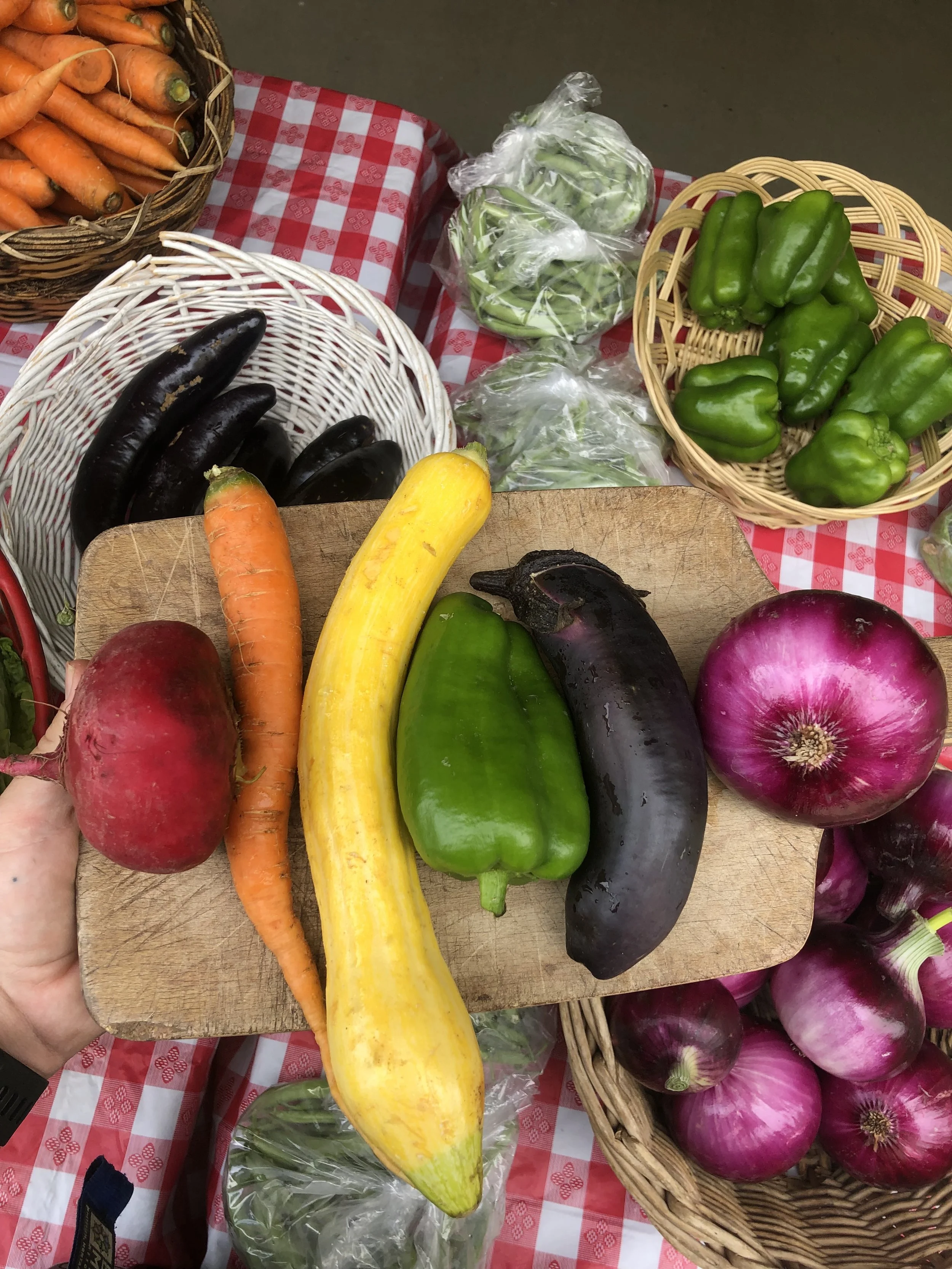
I sat down with Jamie, a fifth-season farmer and new member of the County Rail Farm. The County Rail is located in Hudson, Montana, about 20 miles north of Missoula. It’s operated by Bethany and Tracy, a queer couple who grow and sell fresh produce at the Missoula Farmers Market. Bethany owns Field Five Flowers, a vibrant and well-loved floral operation growing amazing blooms for u-pick, weddings and events, and local shops and markets.
Jamie spoke with humor and honesty about what it means to farm as a queer person in Montana—where open skies and open identities don’t always go hand in hand.
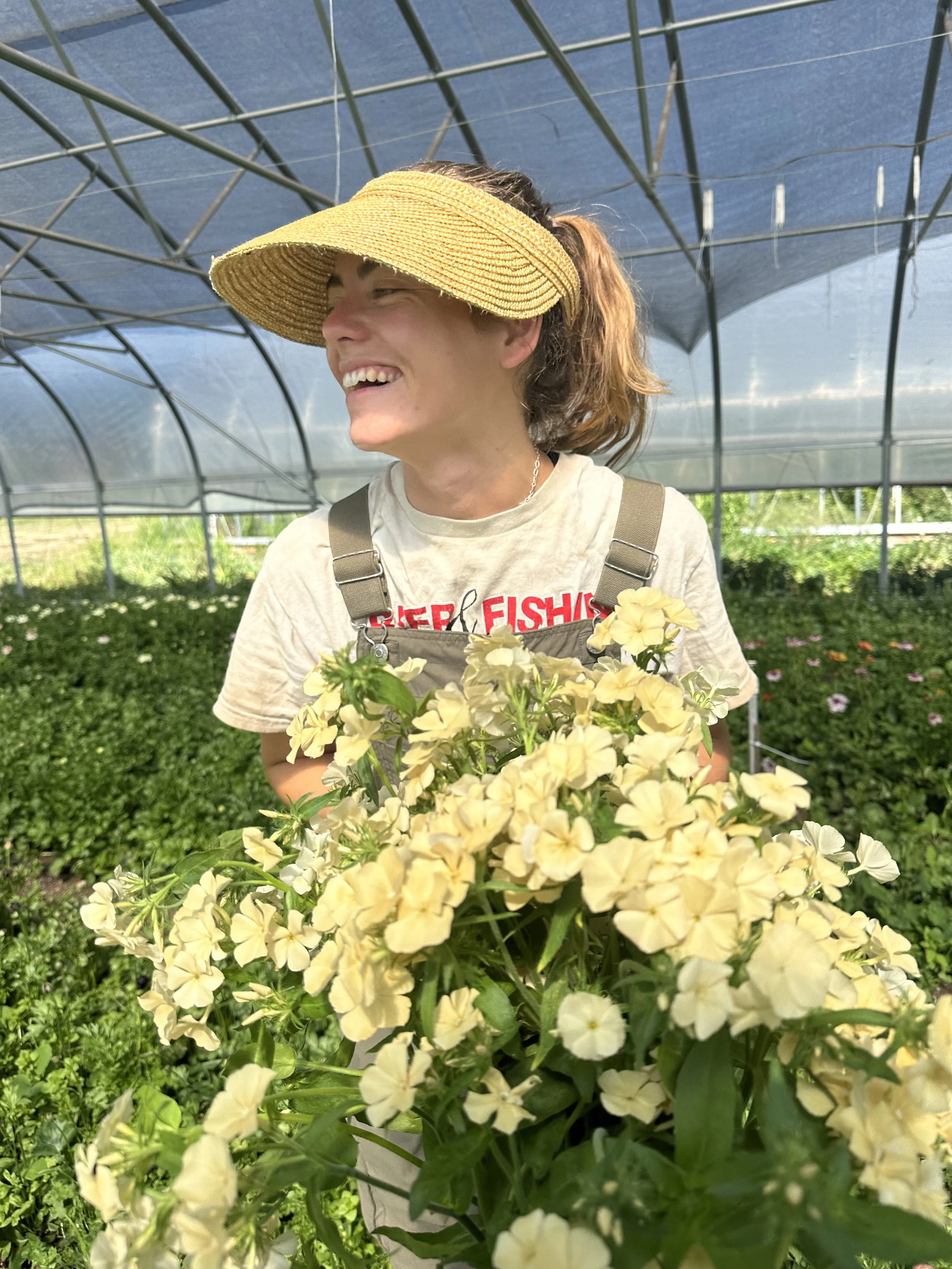
Jamie holding a bouquet of fresh picked flowers harvested for Field Five Flowers.
How does your queer identity and your relationship to the land intersect or influence each other?
“ The onset of me realizing that I was queer is directly related to me farming. Like, that's how it happened for me because I was working on this farm in San. Ignatius and my other two coworkers were queer. And I had the freest summer of my life. And I felt, so myself, I was outside all the time. I had hands and dirt, all the time. I've never felt so connected to a place, and I've also never felt so connected to people. There's something here, the way these people see themselves in relation to nature and in relation to the rest of the world, there's like a spaciousness here and a sense of possibility.”
She reflected on how the natural world resonated with her.
“Things aren't following a specific societal pattern. They are like, existing in a way that's free and complicated and beautiful, which is the weirdest. Which is queerness.
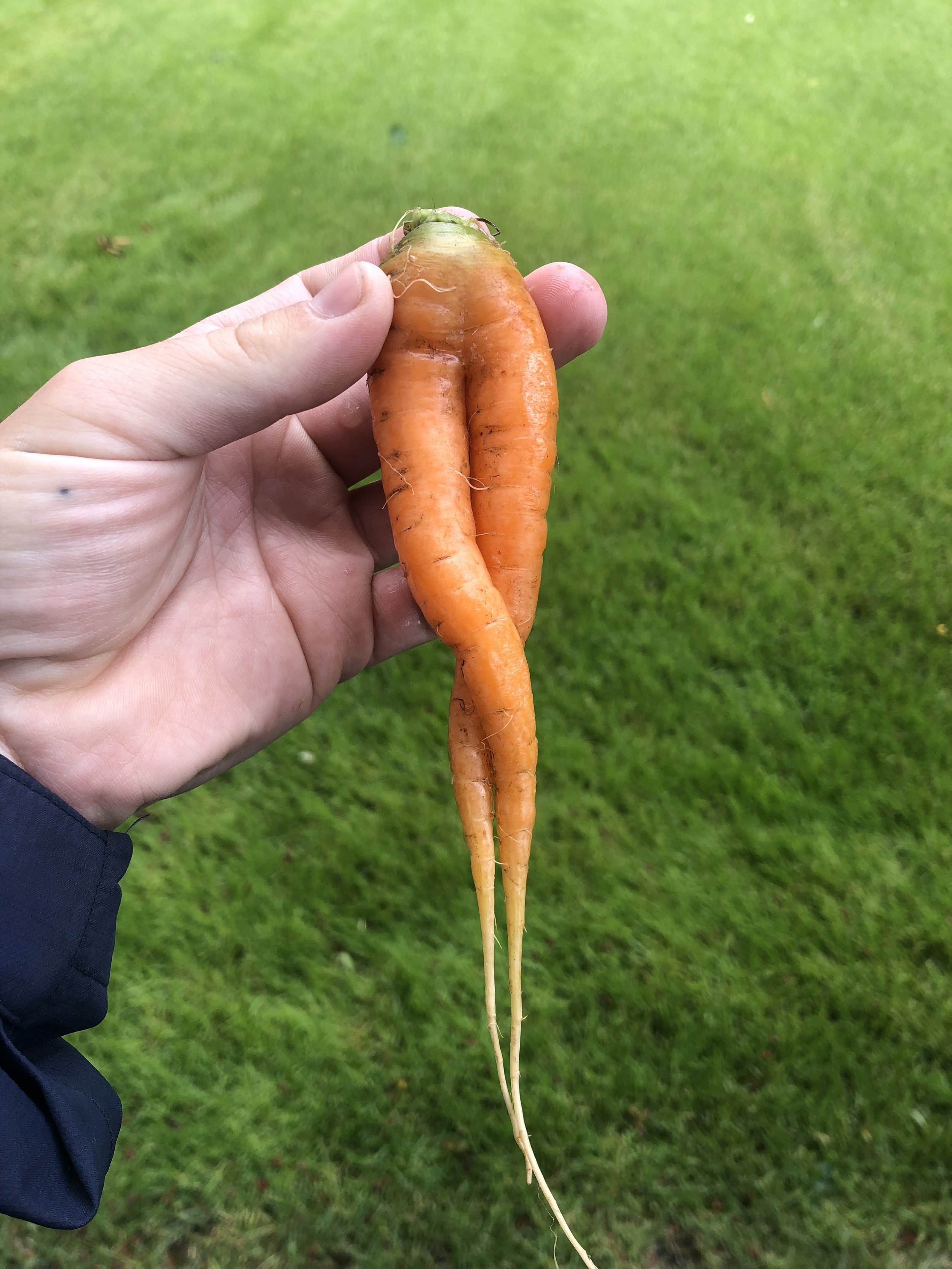
Unique carrot crossing its legs
What can we learn from having a queer mindset when farming?
“First of all, it makes things so much more fun. The thing that comes to mind is weird vegetables. I think that feels very queer to me that, once you start growing food, you realize that the food you have been buying from the grocery store is so normal and boring.”
She recalled harvesting quirky, misshapen vegetables alongside her farm crew, moments filled with laughter.
“ We're just harvesting carrots, and we're like, look at this carrot. Look at these carrots. These carrots grew into each other. Look at this potato. Look, look at the color of this one. And I feel that way with flower farming too, where it's like, these two emerged. It's two different colors. I think that like, is very queer. And itself to be like, it's so beautiful, how everything is not the same.
Her eyes lit up as she spoke of each oddly shaped vegetables. Describing them as treasures to be cherished, rather than something to be discarded for their uniqueness—as so often happens in large-scale farming.
“It's celebrating differences every day in this silly way of course. But I think that makes a big difference for how you look at the world. Then you start looking around at the food you're eating, and just how boxed in everything is. And you realize that you don't have to do that at all! It's okay for it to be fun, and it's okay for it to be silly, and it's okay for it to be a little bit strange”
What are the joys and challenges of being queer within farm culture?
Really early on at County Rail. Tracy (Farm Owner) was like, I want you to learn how to use the tractor. Like, you're going to learn how to use the tractor.
But also I'm going to walk you through, step by step. It's not going to be intimidating. You can totally do it. It's going to be great.
That makes me emotional because it's this information that's been gatekept from so many people for so long.
Did you have that to other farms where they just wouldn't let you touch machinery?
Yes! It felt like you would really have to be like, you have to teach me! You would have to be so assertive and that feels really scary.
I think there's so much queerness in information sharing and collaboration and being like, please ask questions, but also you were so capable of doing this and you are not alone.
While the historical context of farming has excluded many individuals from learning critical skills such as how to use farm equipment, Jamie’s experience—with a boss who was willing to slow down, teach, and offer support serves as a strong example of queer ecology in action.
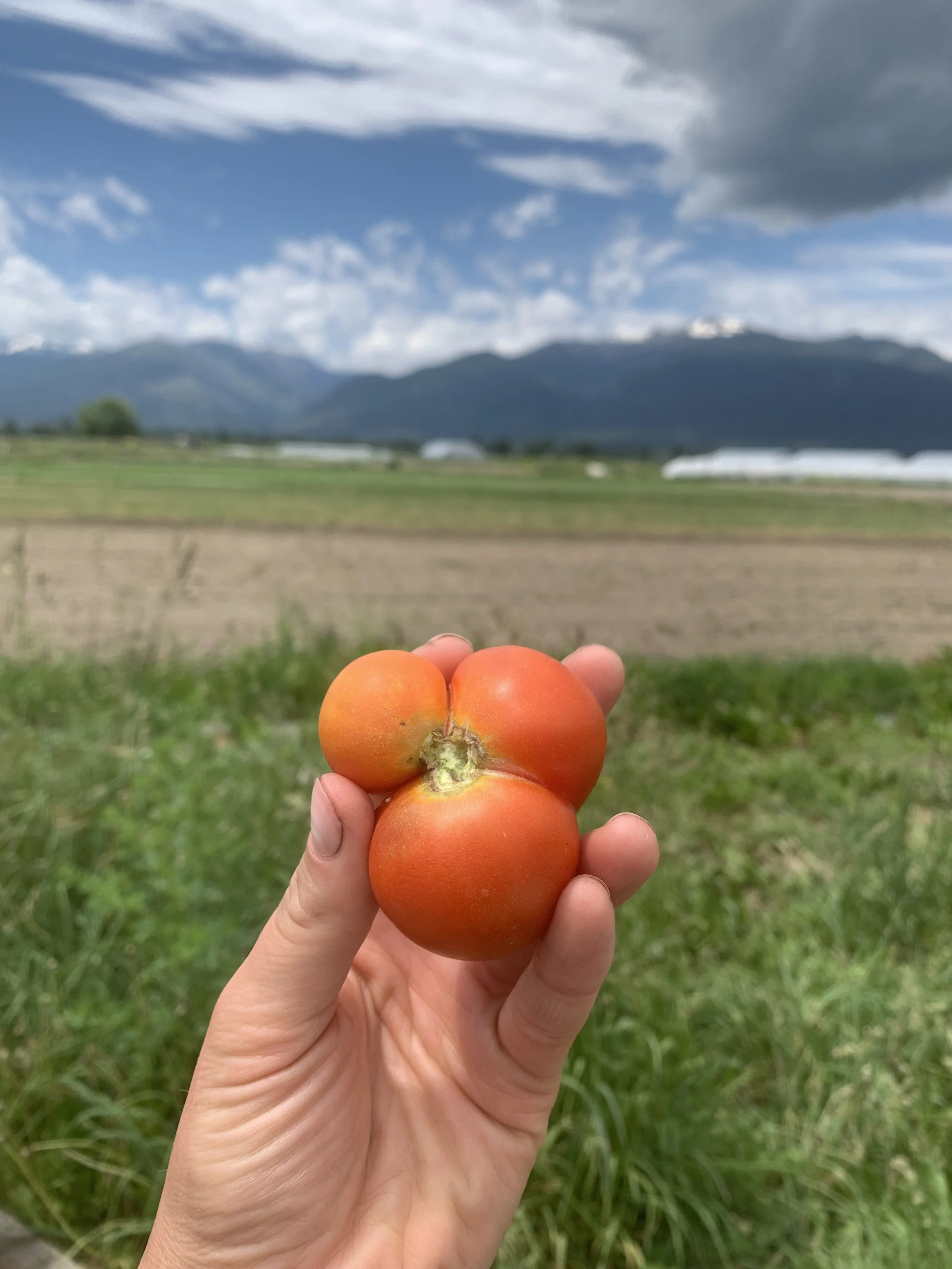
A unique tomato with Bitterroot Mountains behind.
Another perspective from queer ecology: recognizing that the heart of the earth operates through community, interdependence, and reciprocity. Jamie explored this idea through her experiences working on small-scale farms.
“Part of why small scale farming feels really queer is because it's like, it's slow and its relational and it's about celebrating these things that all of these hands made possible rather than, thinking about efficiency all the time in a way that is like without joy feels like the opposite of what I want.
She went on to express her gratitude for all the pieces that make small-scale farming possible.
It's pretty amazing to both feel a sense of interdependence with the people you're working with and the people who are supporting you by buying the food or the flowers. The grants that you received, like all of the things.
Growing food, we are still so in the minority to be growing food in this way. There are a lot of people who have worked really hard to make it possible, even though it's so not perfect.

Celebrating a quirky leek!
As our joy-filled, queer-rooted conversation came to a close, I asked one final question—hoping to carry the spirit of our exchange into a vision for the future.
What are your hopes or visions for the future of queer farming?
“I wish for farmers to feel enough support and for our systems of, like, food sharing, food access to be strong enough that they can really grow what they want to grow.”
She elaborated on the tight margins and difficulty being a small scale farmer.
“There's still so much pressure to just exist within capitalism. To grow what's profitable to cater to other people. So in my best imagination, you could make a living as a farmer, growing what you want, and things could look wacky and you could pay people enough. And everyone could get it.”
She reflected on her hope that the joy she found in queer farming would ripple out and reach others.
“Even if you are not a farmer that you can feel this sense of kinship, this sense of like liberation, this sense of, feeling enough belonging both to place and with other people that you can just be exactly who you are.”
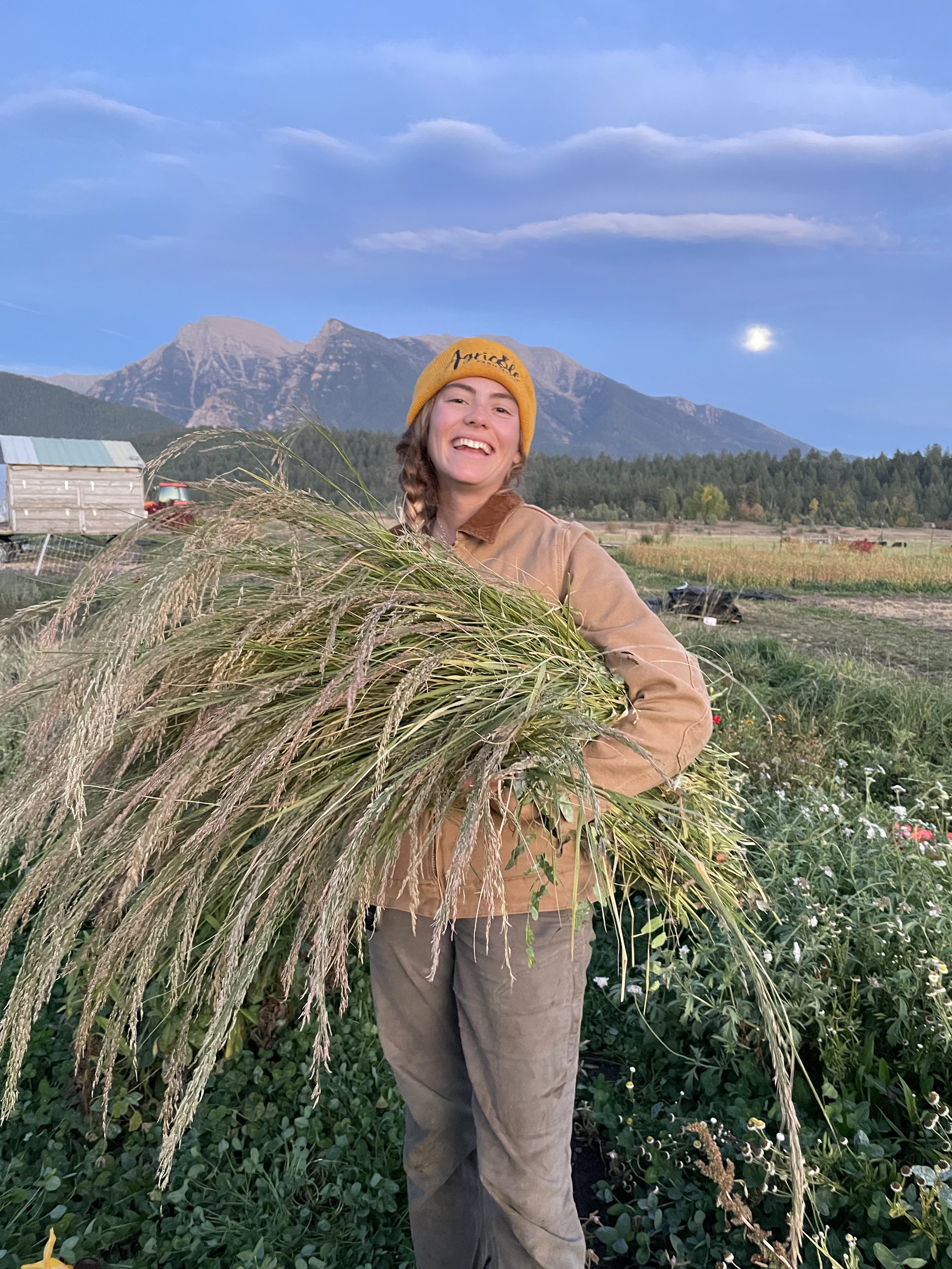
Jamie holding a bundle of grass smiling as the moon rises behind the Mission Mountains.
Talking with Jamie, hearing her insights, reminded me how queerness can expand past an identity and become a model for working with land, community, and self. Queer farming isn’t just about who you are—it’s about how you live. It’s about choosing interdependence over independence, joy over efficiency, care over control. It’s about celebrating the crooked carrots, sharing tractor knowledge, and seeing the powerful truth that our earth is rooted in queerness.